
A Bible lesson by Ivor Jefferies
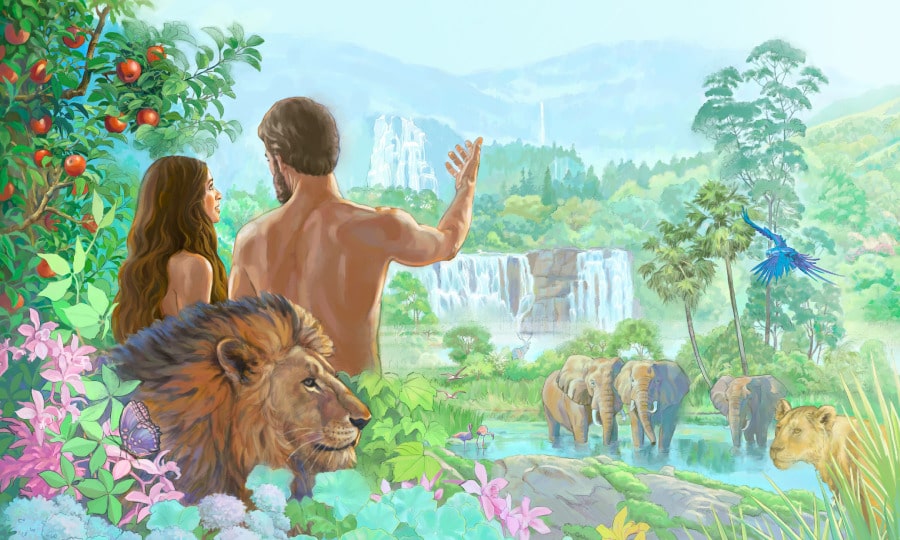
1. What agreement did God make with Adam in the Garden of Eden?1
Read Gen. 2:9, 15-17, cf. Lev. 18:5, Rom. 10:5, 7:10a, 2:14-15.
2. What was the penalty for breaking God’s covenant2 or agreement, and what other results followed?
Read Gen. 2:17, 3:11, 16-19, 23-24, 5:5, Rom. 5:12, 18a, 19a.
Adam experienced some kind of spiritual death upon sinning, and the second death of hell would follow (Eph. 2:1, Rev. 21:8). And yet God threatened that Adam would die on the very day he sinned (Gen. 2:17). This might mean that death set in the moment Adam sinned, and would finally take its toll (Gen. 5:5). More probably it means that Adam would drop down dead the moment he sinned. Why did this not happen? It did in fact happen through the death of a substitute (Gen. 3:21).
3. How is Gen. 3:9, 15b, 17b, 18, 21b a picture of Christ?
Read Luke 19:10, 1 John 3:8b, Gal. 3:13, Matt. 27:29, John 1:29, 2 Cor. 5:21.
Before the creation God made a covenant of redemption with his Son. He introduced it immediately after the Fall. The moment God the Creator was revealed as God the Judge, Adam also met Him as God the Saviour.
4. How did Christ obey the covenant of works?
Read Matt. 3:17, 4:1-11, John 8:29, 46, 17:4, Phil. 2:8, 1 Pet. 2:22.
5. In what sense is it true to say that we are saved by works, and in what sense are we saved by grace alone?
Read Gal. 4:4, Rom. 5:18b, 19b, 3:20, 23-24, 28.
It is not enough to say that Jesus died for our sins, for He first had to live in our place. If Jesus committed even one sin, He would’ve had to die for his own sin and could not be our substitute. Thanks be to God that Jesus kept the law perfectly. Through faith in Jesus Christ God accepts his perfect life as if we lived it, and his death as payment for all or sins (Phil. 3:9, Col. 2:14).
6. We can never earn God’s favour through the law. Where do our works fit into our salvation?
Read Eph. 2:8-10, Jas. 2:14-26.
7. What Adam lost by breaking the covenant of works, Christ regained. What did He regain for us?
Read John 10:10, 11:25-26, 17:3, 1 John 1:3, Rev. 22:14.
By eating of the forbidden tree, Adam lost access to the tree of life (Gen. 3:24). And by hanging on a cursed tree, Jesus reopened the way to the tree of life (Rev. 22:14). The cross is our key to Paradise.
1 This is also known as the covenant of works where Adam’s relationship with God depended on his works of obedience.
2 Hos. 6:7 says that Israel broke God’s covenant just like Adam did. Some translations interpret this to mean that Israel broke God’s covenant at a city called Adam (cf. Jos. 3:16). However, the Hebrew word ke means “like” rather than “at” (cf. Job 31:33, ESV footnote). Other translations take ādām to mean that Israel sinned like men. But for Israel to sin like men would imply that they themselves aren’t men. Besides, the Hebrew uses a singular, not a plural (Adam or man, not men). Besides, what does it mean to break the covenant like a man except that the man broke God’s covenant in the Garden of Eden? The text concludes by saying that there—in the Garden with Adam as our representative—we all dealt faithlessly with God.